Shopify Horizon Theme: Should Merchants Upgrade in 2026?
Horizon is Shopify's new flagship theme — nested blocks, global blocks, AI block generation, and a far better editor. But is it worth migrating your existing store in 2026? Here's what Horizon does better than Dawn, where it still trails on mobile performance, why the move is a rebuild not a swap, and a clear decision framework.

The short answer: Horizon is genuinely the future of Shopify themes — but "should you upgrade?" isn't a yes/no. If you're launching a new store or redesigning from scratch in 2026, build on Horizon. If you run a mature, well-performing store on Dawn and aren't redesigning, there's no urgent reason to migrate yet — the move is a rebuild, and Horizon still starts behind Dawn on mobile performance.
We build and migrate Shopify themes, so here's the honest breakdown.
What Horizon actually is
Horizon is Shopify's new default free theme for new stores, built on the Horizon Framework. It's not a reskinned Dawn — it's a different architecture:
- Nested blocks — blocks inside blocks, for far more layout flexibility.
- Global blocks — change a block once and it updates everywhere it's used (Dawn makes you update each page manually).
- AI block generation — create blocks from natural-language prompts.
And the editor is the biggest day-to-day change. Dawn's editor is essentially the one it shipped with in 2021; Horizon's adds hover-to-preview before adding a block, direct text editing on the canvas, copy/paste blocks across templates, right-click duplicate/delete/hide/move, and conditional settings that hide irrelevant fields. If you spend real time in the theme editor, it's a noticeably better experience.
What's genuinely better
For building and maintaining a store, Horizon is a step up:
- Editing speed. Copy/paste across templates, hover preview, and on-canvas text edits remove a lot of the click-heavy friction of Dawn.
- Global blocks. Update your promo banner, USP row, or footer block once — it propagates everywhere. This alone saves hours on stores with repeated content.
- AI blocks. Describe what you want; get a starting block. Still maturing, but a real accelerator for rough-drafting layouts.
- Faster update cadence. Horizon is where Shopify is putting its theme investment, so it's improving quarter over quarter — while Dawn is stable but essentially static.
The catch #1: mobile performance
This is the honest counterweight. In demo PageSpeed tests, Horizon scores around 52 on mobile versus Dawn's ~82 — a real gap. On desktop they're near parity (~97).
Two important caveats, though:
- The gap is closing. Horizon has gained roughly 5 mobile PageSpeed points per quarter since launch while Dawn stays flat. Projections put the mobile gap at 10–15 points by late 2026, not 30.
- Your build matters more than the base theme. A bloated Dawn store with heavy apps and unoptimized images will lose to a carefully built Horizon store. The demo score is a starting point, not your destiny.
Still, if a mobile PageSpeed above 80 is a hard requirement for you today, Dawn currently starts you closer to it — and mobile performance feeds both conversions and AI/SEO discovery.
The catch #2: migrating is a rebuild, not a swap
There is no automatic translation between Dawn's section model and Horizon's nested-block model. If you switch themes, your homepage resets to Horizon defaults and you rebuild your templates. That's not a five-minute theme swap — it's a design-and-build project with real time and budget attached.
This is the single biggest reason not to migrate a working store on a whim. If your Dawn store is converting well, "upgrading" the theme means rebuilding it — with all the QA and regression risk that implies.
The decision framework
| Go Horizon if… | Stay on Dawn (for now) if… |
|---|---|
| You're launching a new store in 2026 | You have a mature, conversion-optimized store and aren't redesigning |
| You're redesigning from scratch anyway | Mobile PageSpeed above 80 is a hard requirement today |
| You spend hours/week in the editor and want AI + global blocks | You have limited time/budget and the current store works |
| You want to build on the architecture Shopify is investing in | You'd be migrating purely for novelty, not need |
Rule of thumb: new build or full redesign → Horizon. Working store you're not redesigning → not yet.
The honest recommendation for existing stores
For most established Dawn stores, the answer in mid-2026 is not yet. Wait until Horizon matures a little further — a 4.x release is expected around late 2026 — by which point the mobile-performance gap should be smaller and AI block generation more capable. Then, if you're due a redesign, do it on Horizon.
The exceptions are clear: if you're starting a new store, begin on Horizon. If you're already committed to a redesign, build the new version on Horizon rather than pouring effort into the older foundation. In both cases you're moving with Shopify's direction instead of against it.
If you do upgrade, treat it as a project
When you do move, don't switch the live theme and hope:
- Build on an unpublished/dev theme first — rebuild templates, migrate content, and QA thoroughly before anything goes live.
- Benchmark performance before and after — measure your real mobile and desktop scores, not the demo theme's, and optimize images, apps, and code.
- Roll out gradually. Shopify's native theme rollouts let you release a new theme to a slice of traffic and even A/B test it before committing — exactly the safe path for a big change like this. (See native A/B testing vs. apps.)
- Re-validate conversions, don't just eyeball the design — a prettier store that converts worse is a loss. (If you're unsure where your conversion leaks are, start with why stores lose sales despite growing traffic.)
We help Shopify brands make this call and execute it — from deciding whether Horizon is right for you, to rebuilding and migrating without tanking performance or conversions. See our Shopify store development work, or talk to us about a Horizon migration or a new build.
Frequently asked questions
What is the Shopify Horizon theme?
Horizon is Shopify's new default free theme for new stores, built on the Horizon Framework. It introduces nested blocks, global blocks, and an AI block generator, alongside a heavily upgraded theme editor — hover-to-preview blocks, direct text editing on the canvas, copy and paste blocks across templates, right-click actions, conditional settings, and AI block generation from natural-language prompts. It's the direction Shopify is taking theme architecture beyond Dawn.
Is Horizon better than Dawn in 2026?
For editor flexibility and build speed, yes — global blocks, nested blocks, AI generation, and a far more modern editing experience. For out-of-the-box mobile performance, not yet: demo PageSpeed tests show Horizon around 52 on mobile versus Dawn around 82, though the two are near parity on desktop (~97). Horizon has been closing the mobile gap by roughly 5 points a quarter, so the gap is shrinking, not static.
Should I migrate my existing store from Dawn to Horizon?
For most well-performing Dawn stores, not urgently. There's no automatic translation between Dawn's section model and Horizon's nested-block model — switching resets your homepage to Horizon defaults and you rebuild your templates. The sensible time to move is when you're redesigning anyway, or once Horizon matures further (a 4.x release is expected around late 2026) and the mobile-performance gap closes.
Should a new Shopify store use Horizon?
Yes. If you're launching a new store or redesigning from scratch in 2026, start on Horizon. You get the modern editor, global and nested blocks, and AI block generation, and you're building on the architecture Shopify is actively investing in — rather than starting new work on the older Dawn foundation.
Is migrating from Dawn to Horizon automatic?
No. Dawn's section model and Horizon's nested-block model aren't interchangeable, so there's no one-click conversion. Moving is effectively a rebuild of your templates on the new theme — which is why it should be planned as a project, not treated as a quick theme swap.
Will Horizon hurt my Core Web Vitals or SEO?
Out of the box it can start behind Dawn on mobile, and mobile performance affects both conversion rate and AI/SEO discovery. But your build quality — apps, image sizes, custom code — matters more than the base theme. A carefully built Horizon store can perform well; a bloated Dawn store won't. Test real performance before and after, don't assume the base theme's demo score is your score.
Building something on Shopify?
We design, build, and maintain Shopify apps, stores, and AI products — to the standard this article describes.
Related reading
Shopify Flow Shipping Label Automation: Setup, Rules, and What Merchants Should Test Before BFCM
Shopify Flow can now buy shipping labels automatically for orders that match your rules. Here's how the action works, example workflows, and what to test before BFCM.
Read article
Shopify Automated Policies: 7 Things Merchants Should Check Before Enabling Them
Shopify can now generate and update your return, shipping, terms of service and contact policies from your store settings. Here's what to check before you turn automation on.
Read article
Shopify Purchase Order Analytics: How to Spot Stock Risks Before BFCM
Shopify Analytics now includes purchase order reports. Here's what each report shows, how to use them to spot stock risks before BFCM, and what they can't tell you.
Read article
Shopify Rollouts: How Merchants Can Safely Test Store Changes Before BFCM
Learn how Shopify Rollouts let merchants schedule, test, and launch store changes safely before BFCM, including themes, discounts, catalogs, and checkout.
Read article
Shopify Shop Checkout Gets Faster: What Merchants Need to Know
Shopify's October 5, 2026 Shop update brings faster checkout and carts that sync across devices. See how it works, who qualifies and what to check before BFCM.
Read article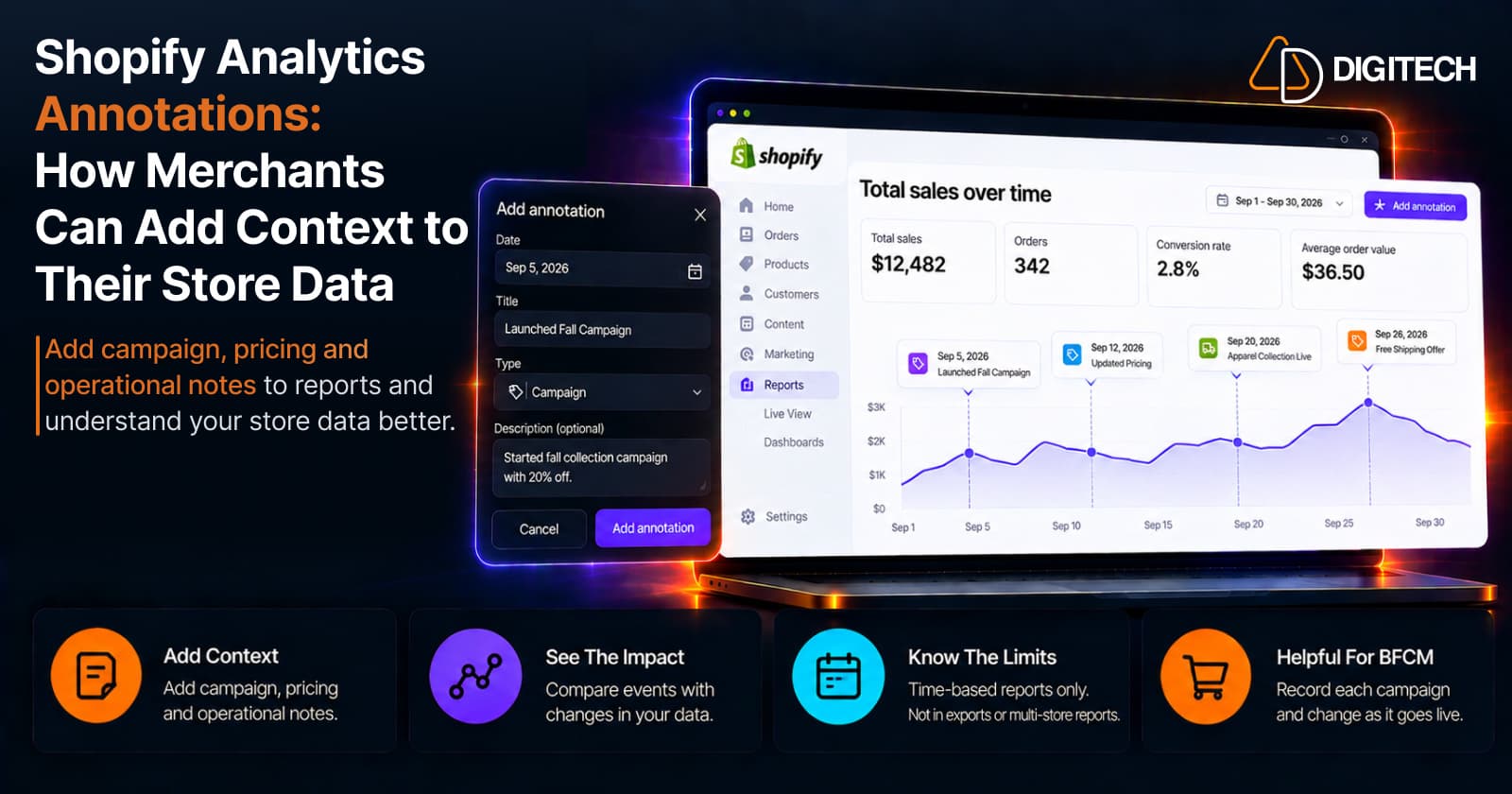
Shopify Analytics Annotations: How Merchants Can Add Context to Their Store Data
Shopify Analytics annotations let merchants add campaign, pricing and operational notes to reports. See how they work, the limits, and how to use them for BFCM.
Read article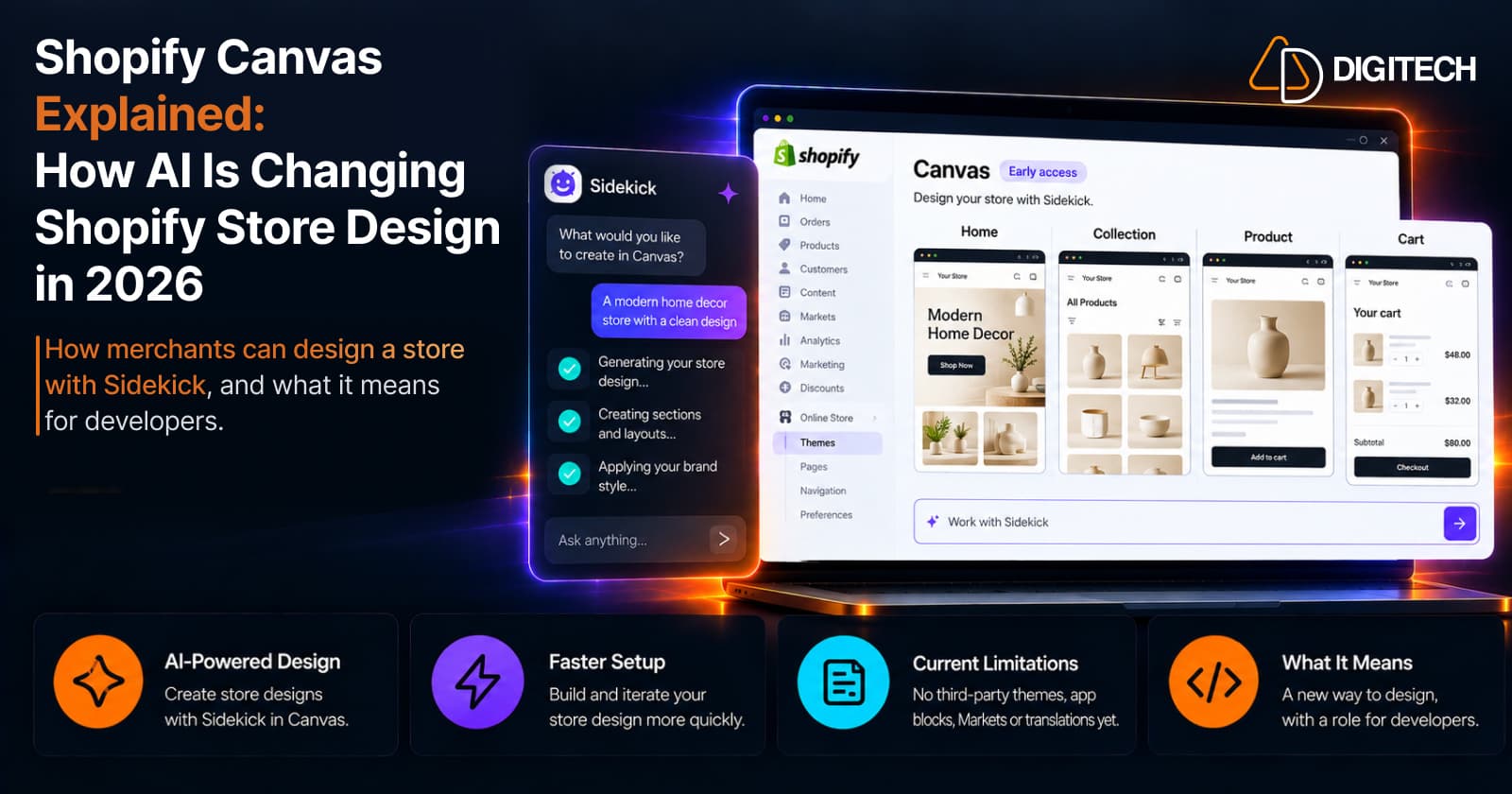
Shopify Canvas Explained: How AI Is Changing Shopify Store Design in 2026
Shopify Canvas, announced October 1, 2026, lets merchants design a store with Sidekick. See how it works, its current limits, and what it means for developers.
Read article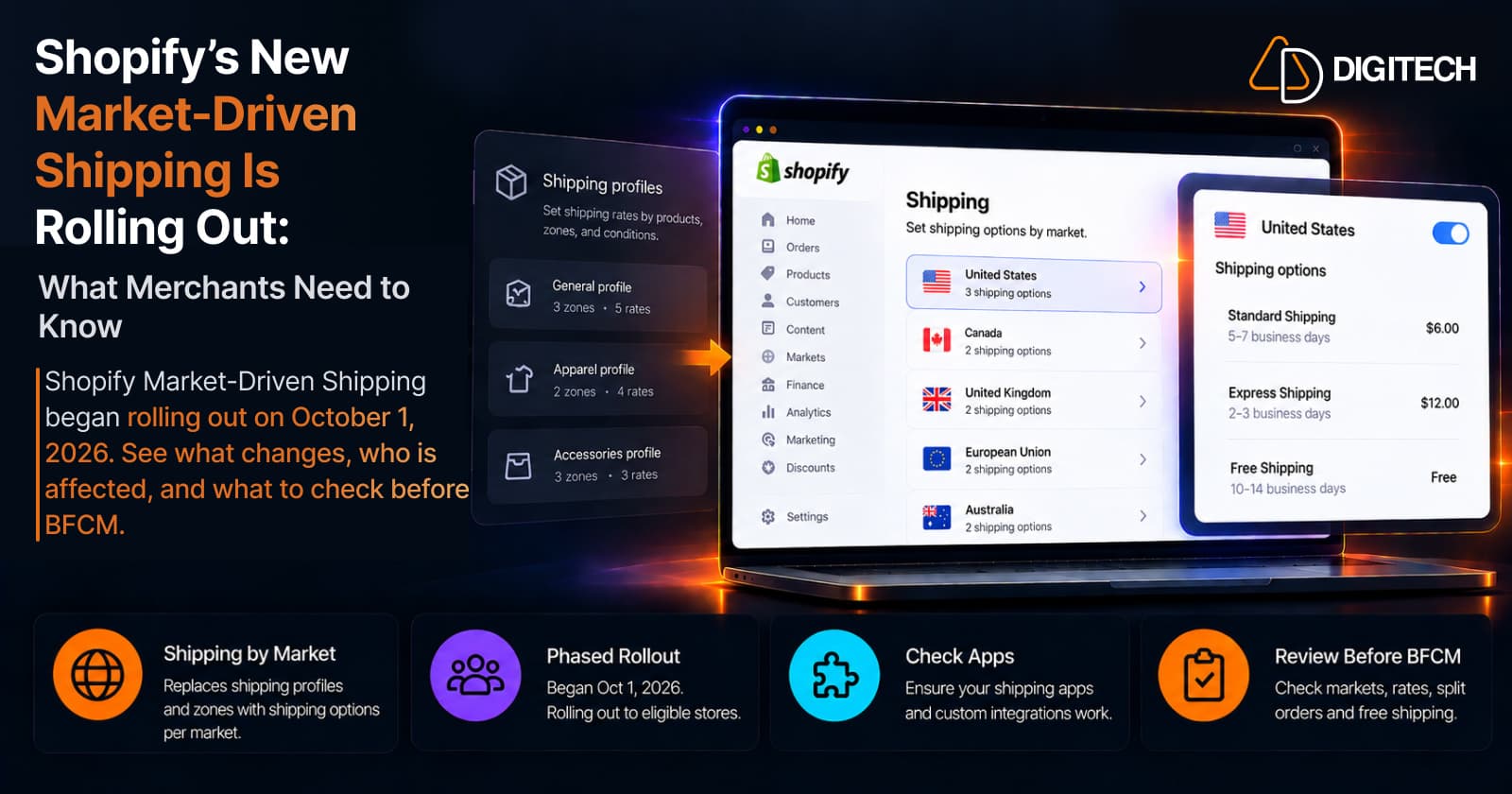
Shopify's New Market-Driven Shipping Is Rolling Out: What Merchants Need to Know
Shopify Market-Driven Shipping began rolling out on October 1, 2026. See what changes, who is affected, and what to check before BFCM.
Read article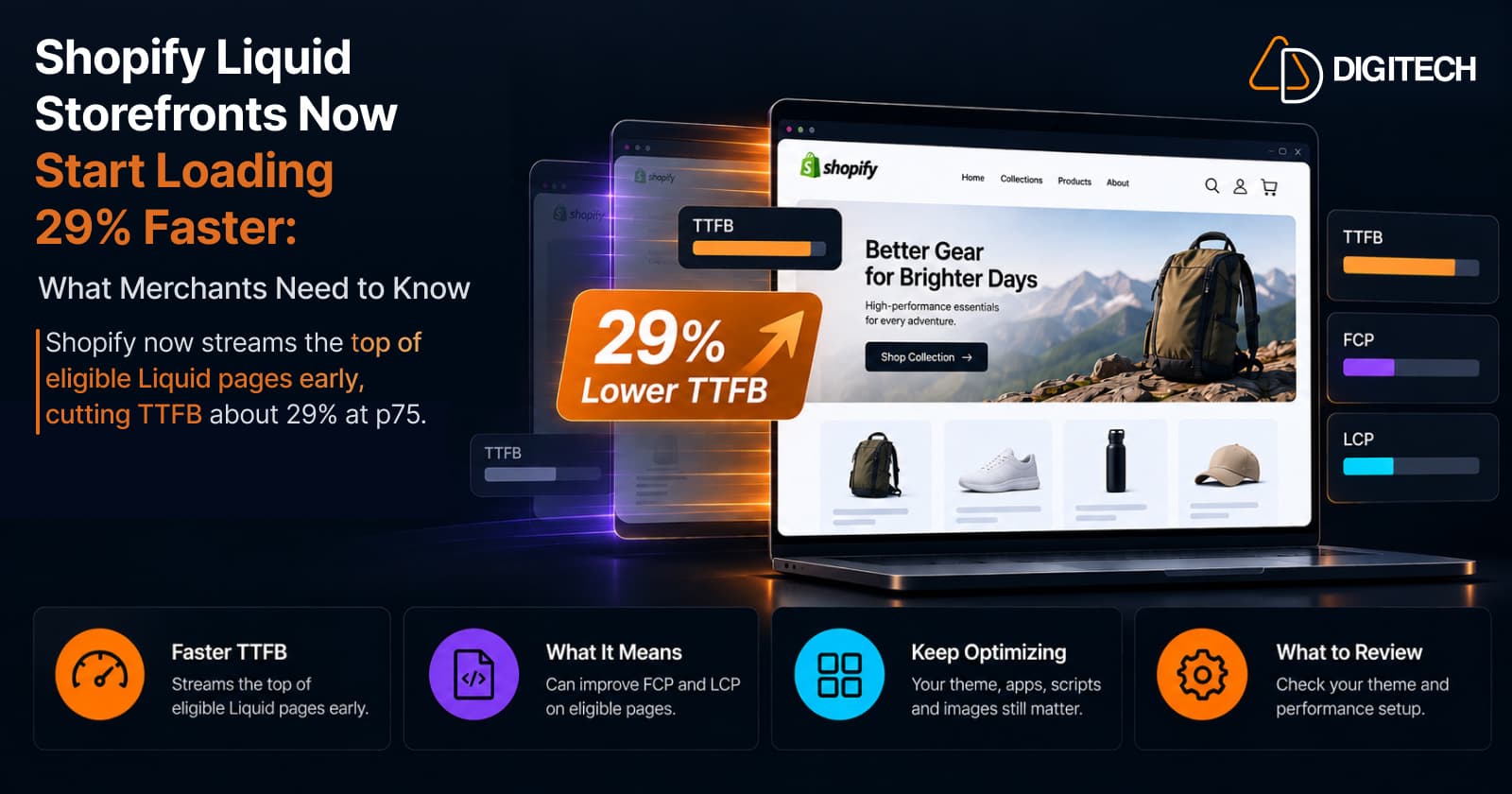
Shopify Liquid Storefronts Now Start Loading 29% Faster: What Merchants Need to Know
Shopify now streams the top of eligible Liquid pages early, cutting TTFB about 29% at p75. What it means for FCP, LCP, your theme, and what still needs fixing.
Read article