Agentic Commerce on Shopify: How to Get Your Store Ready for AI Shopping Agents (2026)
Shopify's Spring '26 Edition makes your products buyable inside ChatGPT, Microsoft Copilot, and Google AI Mode. Here's what agentic commerce actually means for merchants — and a practical, no-hype checklist to get your Shopify store ready for AI shopping agents in 2026.
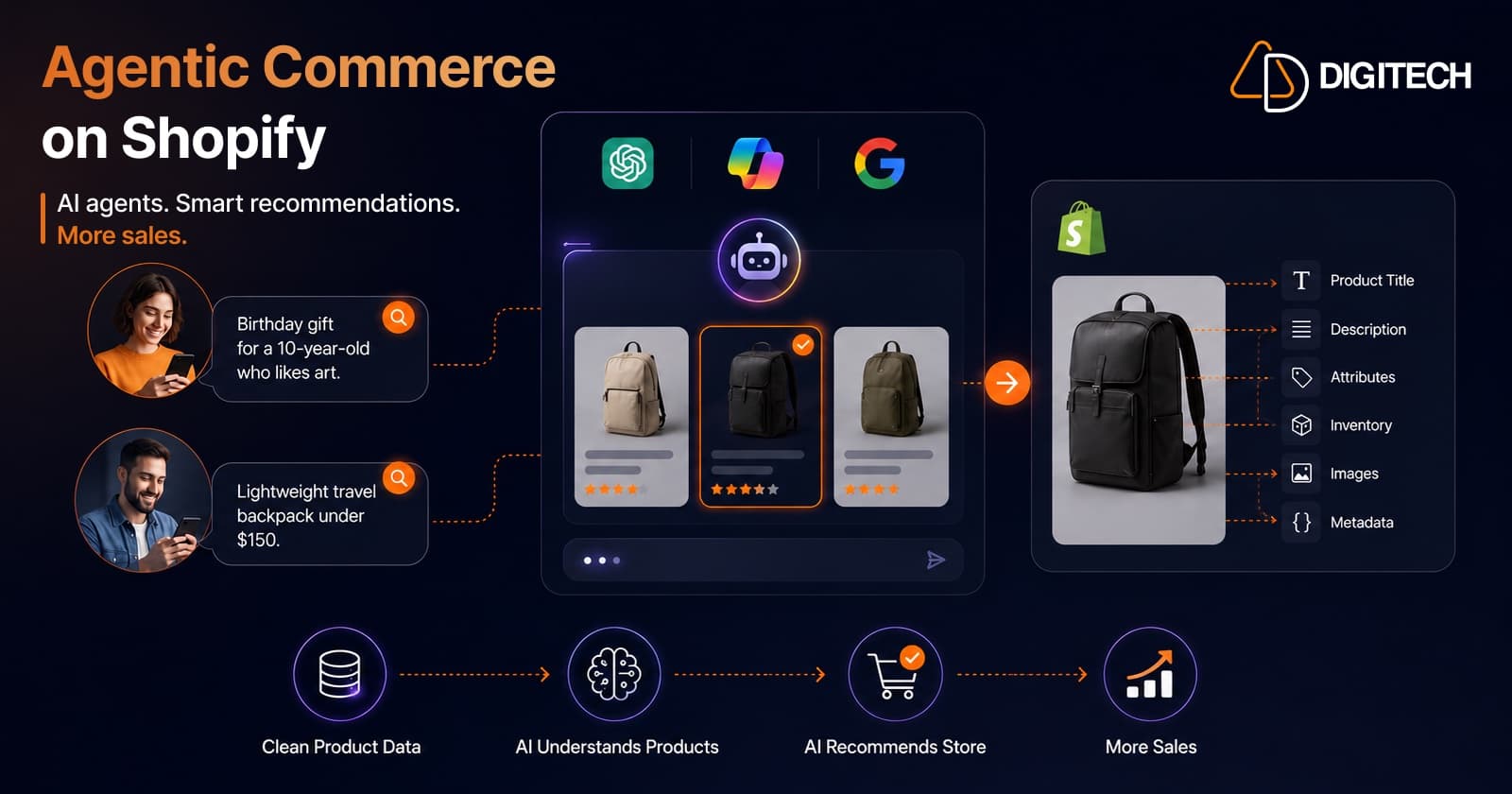
The short version: agentic commerce means your customers are starting to discover and buy products inside AI assistants — ChatGPT, Copilot, Google's AI Mode — and getting your Shopify store ready is mostly about product-data quality and flipping on one sales channel, not a re-platform.
Shopify's Spring '26 Edition (June 17, 2026 — 150+ updates) put agentic commerce front and center. We build and scale Shopify stores, so this is the guide we're walking clients through right now: what "agentic commerce" actually means, what Shopify shipped, and a concrete checklist to make sure AI agents can find — and sell — your products.
What "agentic commerce" actually means
Traditional commerce: a shopper lands on your store, browses, and checks out. Agentic commerce flips the entry point. The shopper asks an AI assistant something like "find me a birthday gift for a 10-year-old who likes art," and the agent does the browsing — it scans products, compares options, and either guides the buyer to your store or completes the purchase right there in the chat.
The critical shift: AI agents don't shop like humans. They don't scroll your homepage or admire your hero image. They read structured data — titles, descriptions, images, pricing, inventory, shipping — and rank what they find. If your product data is thin, messy, or out of date, the agent simply recommends a competitor whose data is cleaner. Discovery becomes a data problem.
What Shopify shipped in the Spring '26 Edition
Three things came together to make this real for merchants:
1. You're now discoverable across the major AI assistants. Through the Agentic Storefronts sales channel, eligible products appear inside ChatGPT, Microsoft Copilot, Google AI Mode, Gemini, and the Shop app — with, in Shopify's words, "no apps to install" and "no additional fees" beyond standard payment processing.
2. Shopify Catalog standardizes and syndicates your data. Catalog uses specialized models to clean and enrich product information, then pushes it across every AI surface and verifies pricing and inventory in real time. Shopify claims data syndicated this way drives 2× more conversion in AI chats than scraped or unstructured data.
3. The Universal Commerce Protocol (UCP) makes checkout work everywhere. UCP — an open standard co-developed with Google and endorsed by 20+ retailers — is the plumbing that lets an agent complete a real transaction (with discounts, loyalty, and subscriptions) on any AI platform. Spring '26 added in-chat checkout in Copilot, with Meta ads coming next.
There's also a standalone Agentic Plan for businesses not using Shopify as their storefront — they can sync products into AI channels and the Shop app and pay only transaction fees, no monthly subscription.
How checkout actually works (so you can trust it)
A fair question: if the sale happens in ChatGPT, is it still my customer? Yes. Here's how it breaks down by surface:
| AI surface | How the shopper checks out |
|---|---|
| ChatGPT | Completes the purchase on your store via an in-app browser |
| Microsoft Copilot | Embedded in-chat checkout (Copilot Checkout) |
| Google AI Mode / Gemini | Streamlined embedded checkout |
| Shop app | Native Shop Pay checkout |
Across all of them, Shopify handles payment processing, tax calculation, fraud detection, and fulfillment — the same engine as your storefront. You keep the order, the customer data, and the margin. The AI assistant is a new front door, not a marketplace middleman taking a cut.
Why this matters now
This isn't a "someday" trend. Shopify reports that since January 2025, AI-driven traffic grew 8× year-over-year and AI-powered orders grew 15×. The behavior is already shifting — people are asking assistants for recommendations instead of opening five tabs.
The risk is asymmetric. If your data is agent-ready, you show up in the AI's shortlist at the exact moment of purchase intent. If it isn't, you're invisible in the conversation — and you won't see it in your analytics, because the shopper never reached your site to bounce. Being left out is silent.
The readiness checklist
Here's the practical part. Most of this is data hygiene you control today — no Plus plan or developer required.
-
Turn on Agentic Storefronts and confirm product eligibility. It's a sales channel in your Shopify admin. Enabling it is the on-ramp; everything below improves how you perform once you're on it.
-
Fix your product titles and descriptions. Write for clarity, not cleverness. An agent matching "waterproof hiking backpack under $150" needs the words "waterproof," "hiking," and the price to be unambiguous in your data — not implied by a lifestyle photo.
-
Fill in structured attributes and metafields. Material, size, color, compatibility, use-case — the structured fields agents filter on. Sparse attributes are the single most common reason a good product gets passed over.
-
Treat images as searchable data. The new Catalog API does image search, returning visually similar products. Clean, high-quality images from multiple angles now influence discovery, not just conversion.
-
Keep inventory and pricing accurate in real time. Catalog verifies both continuously. An agent that surfaces an out-of-stock or mispriced item erodes trust fast — and Shopify pulls real-time signals straight from your admin.
-
Add reviews and ratings. Agents weigh social proof heavily when ranking options. Make sure review data is present and structured.
-
Handle product compliance disclosures. Spring '26 lets you attach mandatory warnings that display on your store, in AI channels, and in the Shop app — important for regulated categories (supplements, electronics, cosmetics).
-
Enable Shop sign-in for personalization. The Catalog API can use a connected Shop account to personalize results, which favors stores that support it.
-
Audit, then monitor. Use Shopify's free AI-readiness audit to scan your product pages for structured-data gaps, consider the Knowledge Base app to control how your brand is described in AI answers, and watch your conversion in AI chats the way you'd watch any channel.
Agentic commerce and AI search are the same discipline
If this checklist feels familiar, that's because it's the commerce version of GEO (Generative Engine Optimization) — getting cited and surfaced by AI rather than ranked by classic search engines. Whether an assistant is answering a question about your brand or recommending a product to buy, it's reading the same structured signals and rewarding the same clarity. Teams that get good at one get the other for free. (It's the throughline in our AI work — including a Built-for-Shopify-certified app that lives in this exact space.)
A note for headless and custom builds
If you run a custom or headless storefront, agentic commerce is also an integration surface, not just a setting. UCP exposes Catalog, Cart, and Checkout capabilities through a public MCP endpoint — developers register an agent profile in the Developer Dashboard and build the full discovery-to-checkout flow with no approval gate. Notably, Shopify also rebuilt Hydrogen to be framework-agnostic (it now works with Next.js), which makes wiring agentic experiences into a custom stack far more realistic. If that's your setup, this is worth scoping deliberately rather than leaving to a default channel toggle.
Where to start
For most merchants, the highest-leverage move this quarter is unglamorous: turn on Agentic Storefronts, then do the product-data cleanup above. That's 80% of the result. The agents are already in your customers' hands — the only question is whether your catalog is legible to them.
We help Shopify brands get agent-ready: data structuring and metafields, channel setup, and Catalog API / headless integration for custom storefronts. If you want a second set of eyes on your store's readiness, take a look at our Shopify store development work or talk to us. And if you're still weighing the platform underneath all this, our guides on Shopify Plus vs Shopify and getting Built for Shopify certified are good next reads.
Frequently asked questions
What is agentic commerce?
Agentic commerce is when shoppers discover and buy products through an AI assistant — like ChatGPT, Microsoft Copilot, or Google's AI Mode — instead of browsing a store themselves. The AI agent reads structured product data, recommends options, and completes the purchase on the shopper's behalf. For merchants, it means the AI assistant becomes a new storefront and a new point of sale.
Can I sell on ChatGPT with Shopify?
Yes. Through Shopify's Agentic Storefronts sales channel, eligible products are automatically discoverable inside ChatGPT, Microsoft Copilot, Google AI Mode, and Gemini — with no apps to install and no fees beyond standard payment processing. In ChatGPT the shopper completes checkout on your store via an in-app browser; Copilot and Google use an embedded checkout. Shopify still handles payment, tax, fraud, and fulfillment, so it's your sale and your customer.
What is the Universal Commerce Protocol (UCP)?
UCP is an open standard Shopify co-developed with Google that lets AI agents discover products and complete checkout on any merchant — the agentic equivalent of what HTTP did for the web. It covers the full journey (discovery, cart, checkout) and supports discount codes, loyalty, and subscriptions. Developers can build against it via a public MCP endpoint with no approval gate.
Do I need Shopify Plus for agentic commerce?
No. Agentic Storefronts is available to standard Shopify plans, not just Plus — the readiness work is mostly about product-data quality, not your plan tier. There's even a standalone Agentic Plan that lets businesses not using Shopify for their storefront sync products into AI channels and the Shop app, paying only transaction fees.
How do I get my Shopify products into AI channels?
Enable the Agentic Storefronts sales channel in your Shopify admin and confirm your products are eligible. Shopify's Catalog then standardizes and syndicates your product data across AI surfaces automatically, verifying pricing and inventory in real time. From there, the work is improving the data agents read: clear titles and descriptions, structured attributes/metafields, accurate inventory, quality images, and reviews.
Building something on Shopify?
We design, build, and maintain Shopify apps, stores, and AI products — to the standard this article describes.
Related reading
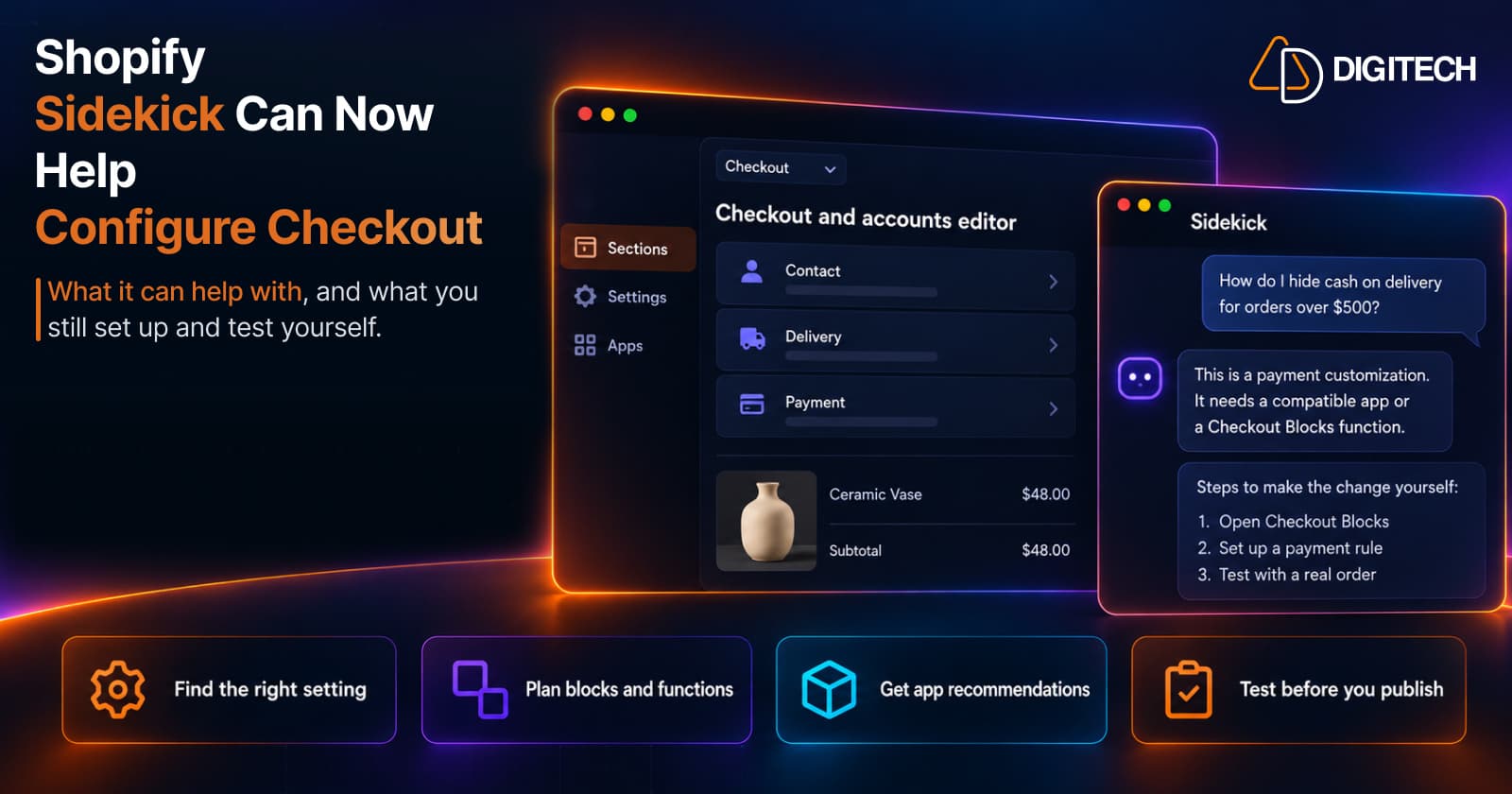
Shopify Sidekick Can Now Help Configure Checkout: What Merchants Should Know in 2026
On October 13, 2026, Shopify added Sidekick to the checkout and accounts editor and the Checkout Blocks app. Here's what it can help with, what you still configure yourself, and the plan limits to know.
Read article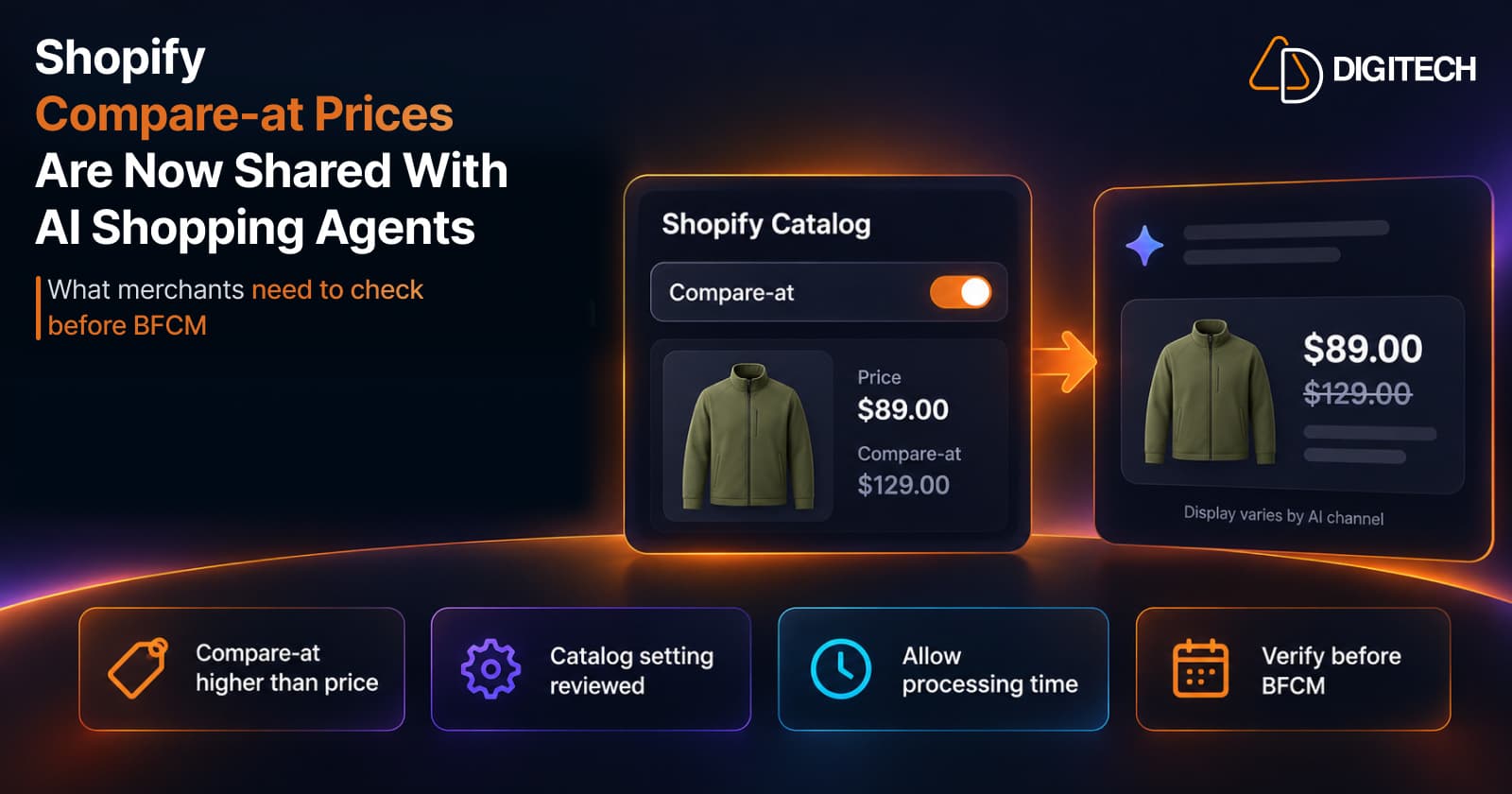
Shopify Compare-at Prices Are Now Shared With AI Shopping Agents: What Merchants Need to Check Before BFCM
Shopify Catalog can now send compare-at prices to AI shopping agents. Here's where the setting lives, how it works, and what to check before BFCM.
Read article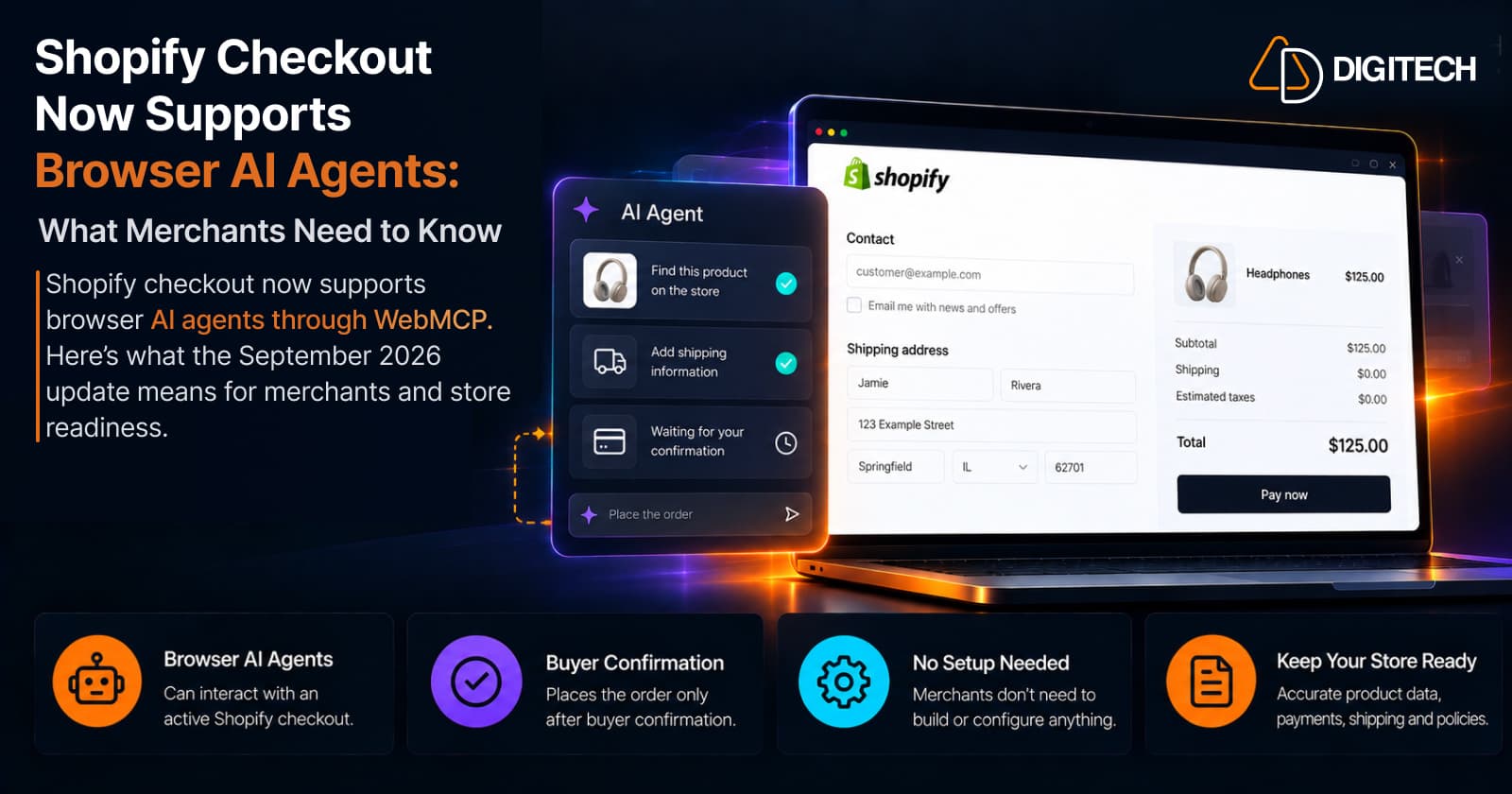
Shopify Checkout Now Supports Browser AI Agents: What Merchants Need to Know
Shopify checkout now supports browser AI agents through WebMCP. Here's what the September 2026 update means for merchants and store readiness.
Read article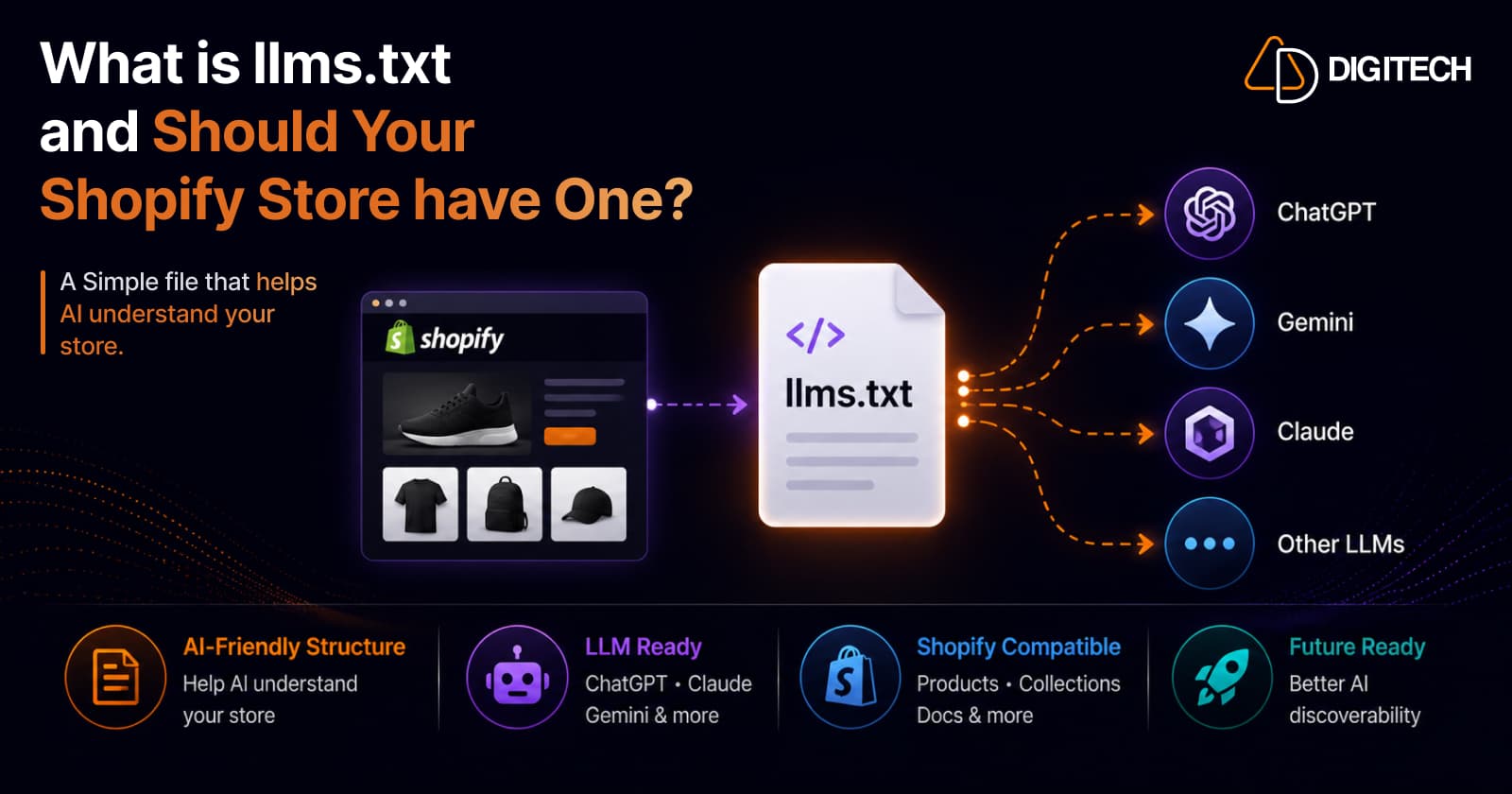
What Is llms.txt and Should Your Shopify Store Have One?
llms.txt is a proposed file that tells AI models which of your pages matter. But here's the honest truth: no major AI platform has confirmed it reads them, and Google said no on the record. So should your Shopify store have one? A qualified yes — as cheap insurance, not a strategy. Here's what it is, what the evidence actually shows, and where AI visibility really comes from.
Read article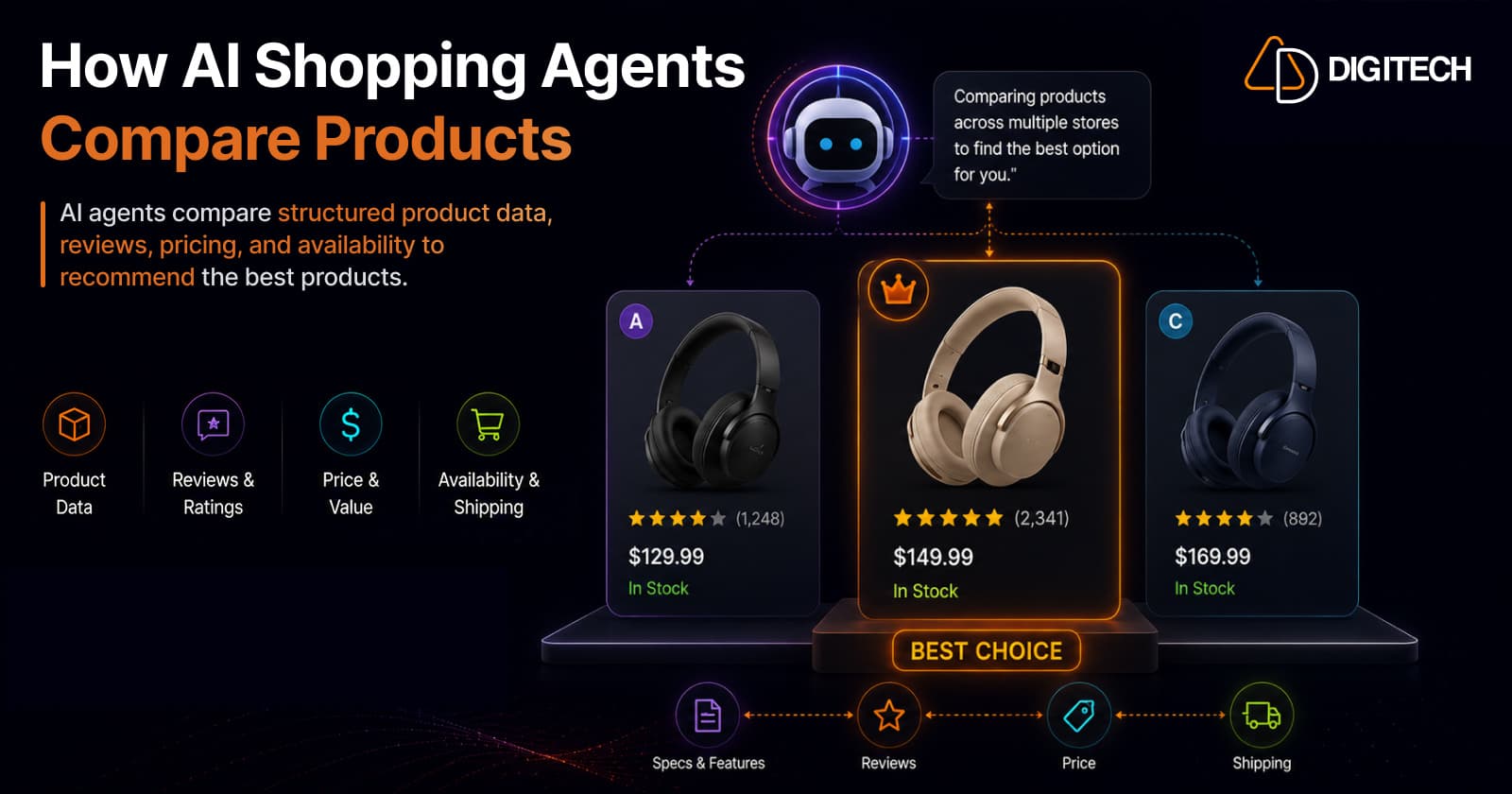
How AI Shopping Agents Compare Products on Shopify Stores
When a shopper asks an AI for the best product, the agent doesn't browse like a human — it reads structured product data across dozens of stores and compares them head-to-head on attributes, value, price, and reviews, then picks winners. Here's exactly how that comparison works, the signals it weighs, and how to make your Shopify products win the shortlist.
Read article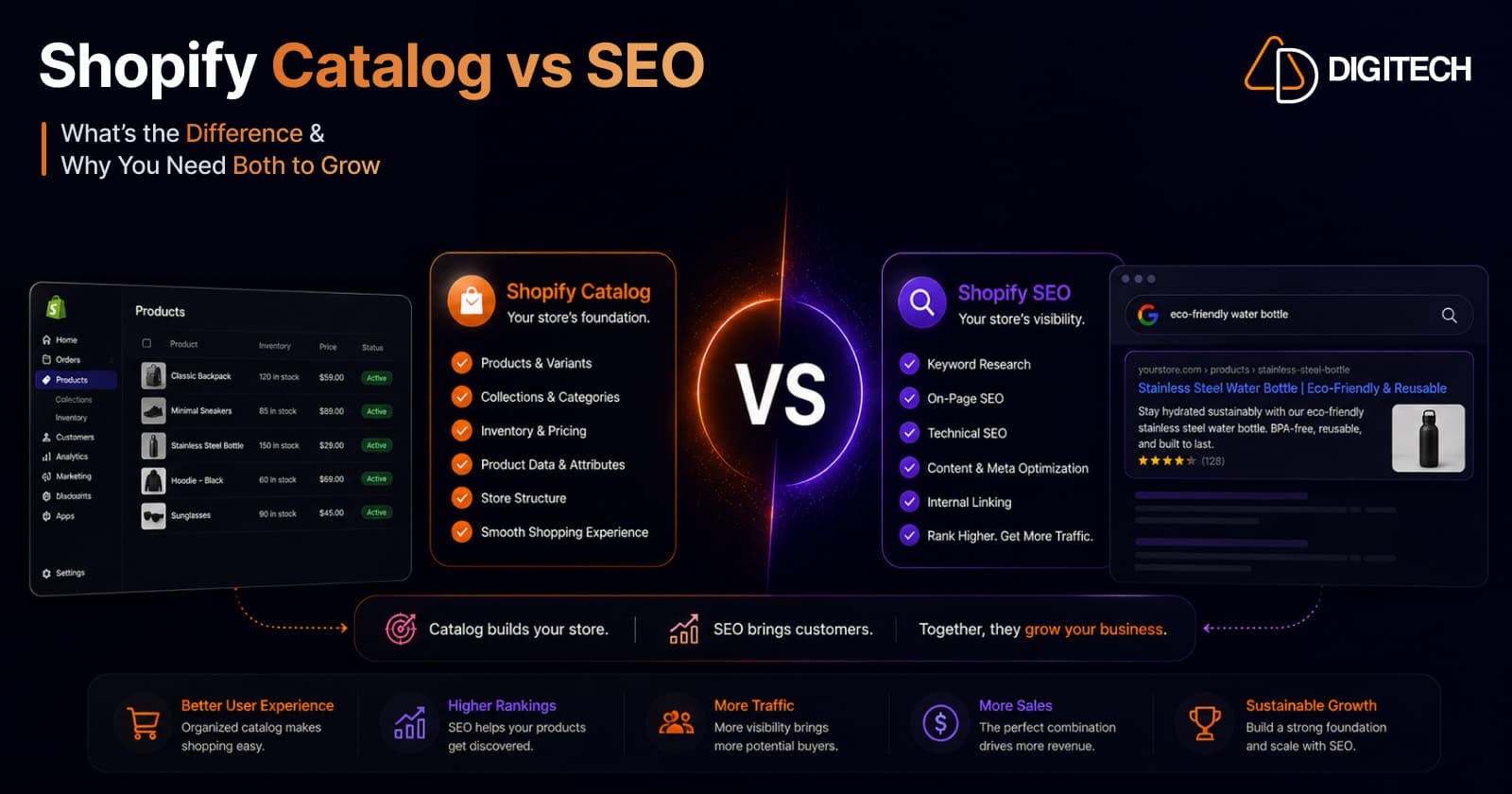
Why Your Shopify Product Catalog Matters More Than SEO in 2026
Discovery is moving from ranked web pages to AI agents that read structured product data. In 2026, the quality of your Shopify Catalog — not your meta tags and backlinks — increasingly decides whether AI recommends and sells your products. Here's why the catalog is the new front page, and what to do about it.
Read article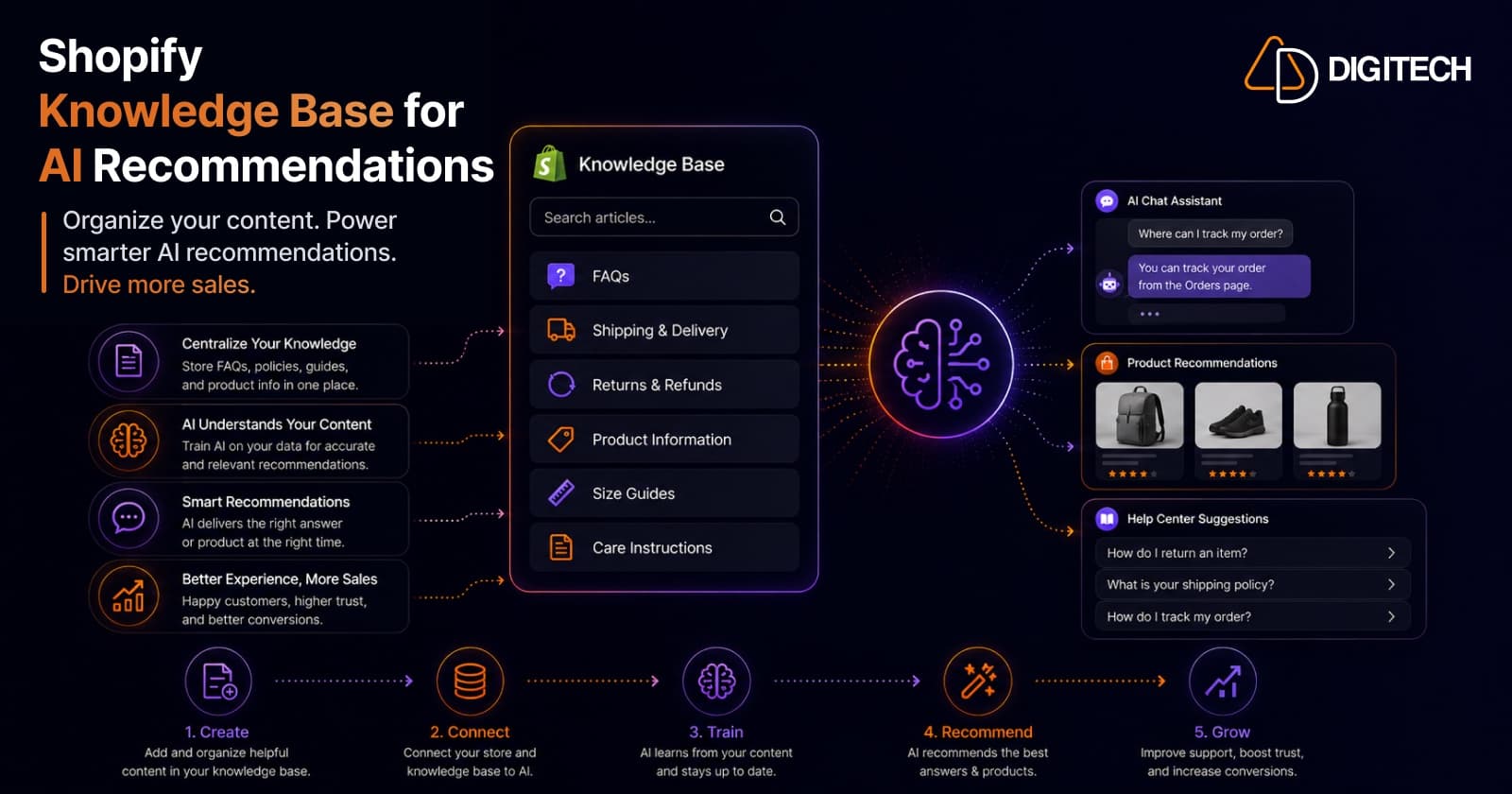
How Shopify Knowledge Base Helps AI Recommend Your Products
AI assistants only recommend products they understand and can answer questions about. Shopify's Knowledge Base feeds your brand context — policies, FAQs, and brand voice — directly to AI, so agents represent you accurately and recommend you instead of a competitor. Here's how it works, why it matters, and what to put in it.
Read article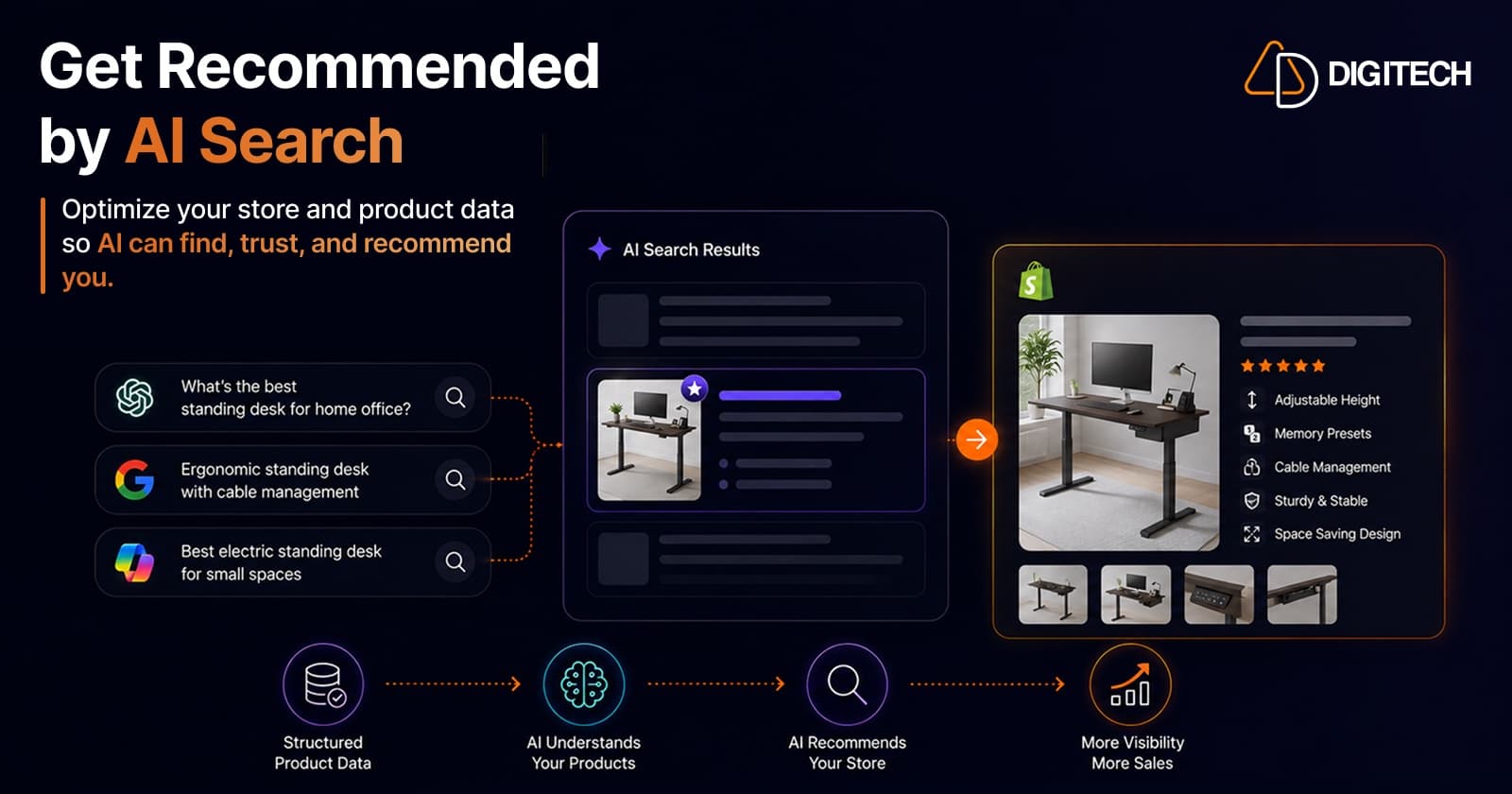
How Shopify Brands Can Get Recommended by ChatGPT, Claude & AI Search Engines
ChatGPT, Claude, and Perplexity now recommend products directly to shoppers. Here's how Shopify brands earn those recommendations — a practical 2026 guide to Generative Engine Optimization (GEO): the signals AI models trust, what to fix on-site and off-site, and how to measure your AI visibility.
Read article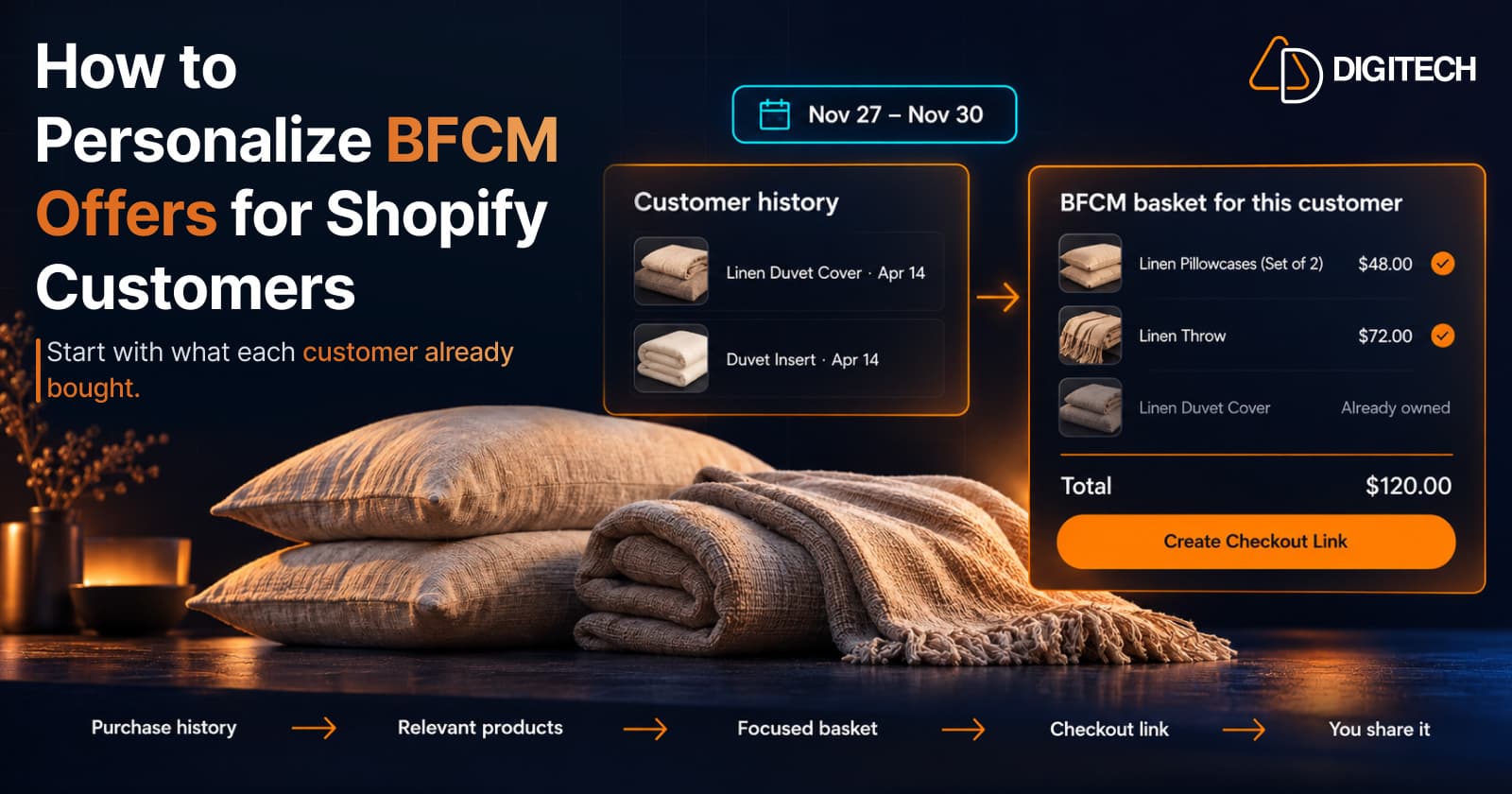
How to Personalize BFCM Offers for Shopify Customers
Use Shopify customer purchase history to build relevant BFCM offers for existing customers: what to check, five ways to personalize, and how to measure it.
Read article